Join

Take 2 tablets daily for 3 days, then 1 tablet daily

  • Step 1AbstainedNo rule reads these words. Dose, frequency and duration stay empty.
  • CutthenThe word the SIG is cut at: step 2 follows step 1.
  • Step 2AbstainedNo rule reads these words. Dose, frequency and duration stay empty.
A synthetic SIG as the seed build reads it: cut into two steps at “then”, with the words of each step left to a pharmacist. Every field stays empty until one fills it.

Rules you can check read what they can prove. A pharmacist decides the rest.

No language model. Where no rule fits, Keystra stops and marks the words. Every action is recorded with who did it and when.

Early access is not open yet. This form does not send anything.

One row, from extract to release.

Follow row 3 of a synthetic catalogue extract through each station Keystra puts it through.

  1. Station 1, Ingest gate: Checked before anything is stored.

    You upload a catalogue extract: one row per distinct SIG, with optional occurrences and dose_form columns. It holds your SIG catalogue, not patient records.

    The ingest gate checks every extract. A single hit rejects the whole file, and there is no override.

  2. Station 2, Read: Read by rules, not a language model.

    A declared grammar and a rule catalogue cut a SIG into steps where a rule fits, such as at the word “then”. Each reading records its engine and rule-set version, and the export carries them.

    If a taper comes out as a single step, the rule sig.taper-single-step@1 flags it, so a missed split does not pass silently.

  3. Station 3, Abstain: Abstains instead of guessing.

    Where no rule fits, the engine stops and marks the words. The field stays empty until a pharmacist fills it.

    The coverage report counts your rows: how many the engine mapped fully, mapped in part or abstained on. It carries no accuracy figure.

  4. Station 4, Decide: A pharmacist decides every row.

    There is no bulk action. Each approval or correction acts on one row at one version.

    A pharmacist can reorder, copy and remove a row’s steps, to fix a split the engine got wrong. An approved row can be reopened.

  5. Station 5, Audit: Every step is written down.

    Every upload, correction, approval, skip, reopening, release and export is recorded with who did it and when. A correction also records the old and new values.

  6. Station 6, Release: What you load is what was signed off.

    A release pins the exact version of every approved row and exports as JSON or CSV.

catalogue-extract.csv6 rows

instruction_textoccurrencesdose_formGate result
Take 1 tablet by mouth once daily412tabletclear
Apply a thin layer to the affected area twice daily96creamclear
Take 2 tablets daily for 3 days, then 1 tablet daily57tabletclear
Instill 1 drop in each eye at bedtime41solutionclear
Take 2 capsules by mouth every 12 hours230capsuleclear
Inhale 2 puffs every 4 hours as needed128inhalantclear

0 hitsStored. One hit would have rejected the whole file.

As it arrivedrow 3 · v1row 3 · v6UnreviewedCorrected

Take 2 tablets daily for 3 days, then 1 tablet daily

  1. Step 1Take 2 tablets daily for 3 days

    • Doseempty2 tabletpharmacist entry
    • Frequencyempty1 time per daypharmacist entry
    • Durationempty3 dayspharmacist entry
  2. Step 2 follows step 1, joined by “then”. The cut is credited togrammar.step-split@1

    Step 21 tablet daily

    • Doseempty1 tabletpharmacist entry
    • Frequencyempty1 time per daypharmacist entry
    • Durationempty
Decided by a pharmacist: row 3 at v6.

Audit record

  1. 09:14:02ingest.acceptedadmin-1catalogue-extract.csv · 6 rows
  2. 09:21:40review.correctedpharmacist-1step 1 · dose · null → {"value":2,"unit":"{tablet}","system":"http://unitsofmeasure.org"}
  3. 09:21:58review.correctedpharmacist-1step 1 · frequency · null → {"times":1,"period":1,"periodUnit":"d"}
  4. 09:22:17review.correctedpharmacist-1step 1 · duration · null → {"value":3,"unit":"d"}
  5. 09:22:41review.correctedpharmacist-1step 2 · dose · null → {"value":1,"unit":"{tablet}","system":"http://unitsofmeasure.org"}
  6. 09:22:55review.correctedpharmacist-1step 2 · frequency · null → {"times":1,"period":1,"periodUnit":"d"}
  7. 09:23:30review.approvedpharmacist-1row 3 · v6

Release 2026.111 row pinned

row 3 at v6

JSONCSV

{
  "catalogueRowId": "6f1c2a4e-9b3d-4e75-8a20-5d7c1e0b9f38",
  "decompositionVersion": 6,
  "engine": { "mode": "seed", "version": "0.1.0", "ruleSetVersion": "36d3ee4489a76be0" },
  "originalText": "Take 2 tablets daily for 3 days, then 1 tablet daily",
  "renderText": "2 tablets once a day for 3 days, then 1 tablet once a day",
  "steps": [
    {
      "sequence": 1,
      "relationship": "start",
      "dose": {
        "value": 2,
        "unit": "{tablet}",
        "system": "http://unitsofmeasure.org"
      },
      "timing": {
        "frequency": { "times": 1, "period": 1, "periodUnit": "d" },
        "boundsDuration": { "value": 3, "unit": "d" }
      }
    },
    {
      "sequence": 2,
      "relationship": "then",
      "dose": {
        "value": 1,
        "unit": "{tablet}",
        "system": "http://unitsofmeasure.org"
      },
      "timing": { "frequency": { "times": 1, "period": 1, "periodUnit": "d" } }
    }
  ],
  "indication": [],
  "untilFinished": false,
  "asDirected": false,
  "canonicalHash": "a6bbbbcdca38754d"
}

09:30:11release.cutadmin-12026.11 · row 3 pinned at v6
Synthetic extract. The steps, the cut and the abstained words are what the deployed seed build does with this text; the pharmacist’s entries, the times and the identifiers are synthetic.

The same row, in 40 seconds.

Silent, 40 s. Synthetic extract. The steps, the cut and the abstained words are what the deployed seed build does with this text; the pharmacist’s entries, the times and the identifiers are synthetic.

The rules mark what they can read. A pharmacist decides.

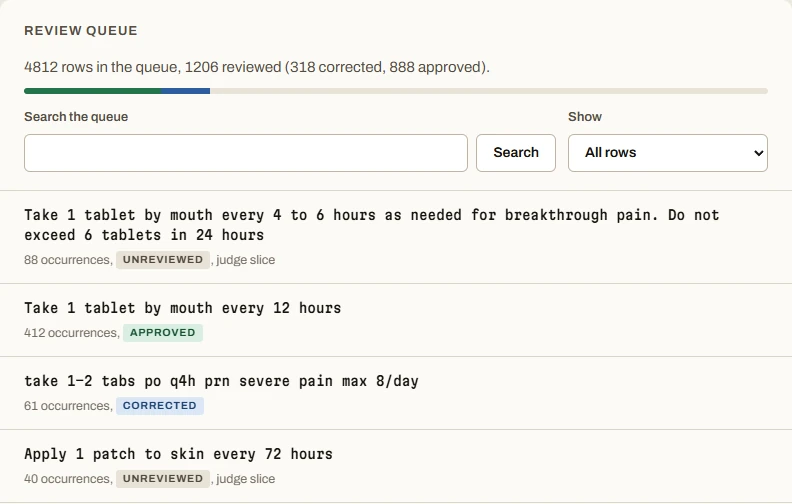
Upload a catalogue extract. Keystra cuts a SIG into steps where a rule fits and marks the words no rule covers. Your pharmacists work the queue one row at a time: approve it, correct a field or its steps, or skip it for later. An approved row can be reopened.

When the rows you need are approved, cut a release. It pins the exact version of each row, so what you load is what your pharmacists signed off.

The review queue: a progress bar, a search box, and SIG rows each marked unreviewed, approved or corrected.
The review queue, on a synthetic tenant. Rows and counts are test fixtures.

For the people who sign

Pharmacy directors and the IT, security and procurement reviewers behind them: this is what Keystra holds and how it is accounted for.

What it touches
Your SIG catalogue: prescription instruction text, uploaded as catalogue extracts. Not patient records.
Before anything is stored
The ingest gate checks every extract. A single hit rejects the whole file, and there is no override.
Between tenants
Each tenant sees only its own rows.
Inside the app
No third-party scripts, fonts or images, and no catalogue text in any address or log line.
Certifications
Keystra holds no compliance certification today, and this page claims none.

Why we built it

SIG catalogues grow by copy and paste. Every system and every year adds its own way of writing “every 4 to 6 hours”, and someone has to make the catalogue exact again.

That work should not mean trusting a model’s guess, or reading every row unaided. So Keystra reads what its rules can account for, says plainly where they cannot, and leaves each decision to a pharmacist.

The Keystra team

Bring your catalogue when access opens.

Early access is not open yet. This form does not send anything.